AI in Human Services: Will We Finally Get a Seat at the Innovation Table?

For decades, human services agencies have been expected to solve society's most complex challenges with yesterday's technology.
We inherit surplus furniture from other departments. We use repurposed laptops. Our visitation rooms are stocked with leftover toys. We often adopt technology years after it has become standard elsewhere.
Yet we serve children, families, older adults, and vulnerable populations whose outcomes can be profoundly impacted by the quality of our systems, tools, and workforce.
This raises an important question:
Why isn't human services prioritized when it comes to innovation?
As artificial intelligence transforms industries across the world, we have an opportunity to change that conversation.
The question is not whether AI can replace human services workers - it can't.
The question is whether AI can help us eliminate administrative burdens, reduce documentation time, improve decision support, streamline eligibility and case management processes, and allow workers to spend more time doing what matters most: serving people.
Imagine if:
Caseworkers could spend less time on paperwork and more time with families.
Supervisors had real-time insights into workload and risk trends.
Families could access services faster and more easily.
Staff could find policy guidance instantly instead of searching through manuals and emails.
Agencies could deploy modern tools at a fraction of the cost of large-scale system replacements.
If AI can deliver measurable improvements in workforce efficiency, employee satisfaction, and client outcomes, then the return on investment may be far greater than the cost of adoption.
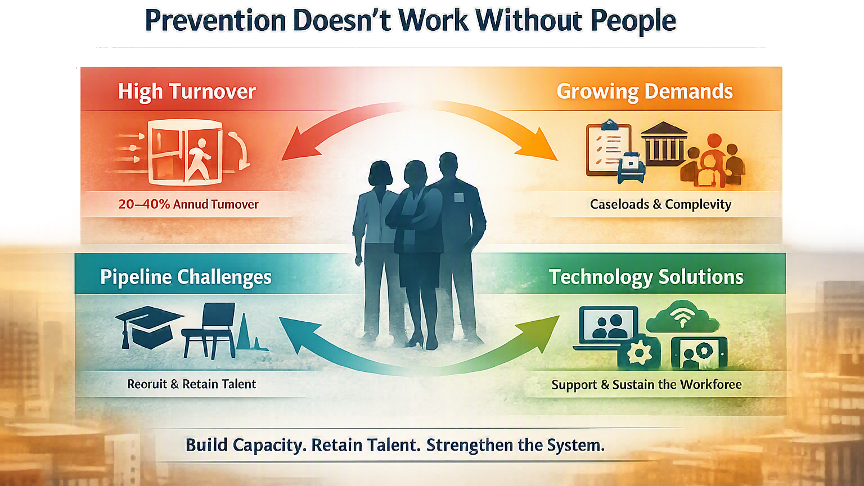
But technology alone isn't the answer.
We also need:
Leadership willing to prioritize human services innovation.
Funding models that invest proactively rather than waiting for systems to fail.
Partnerships between practitioners and technology providers.
A commitment to ensuring all agencies—not just the largest or best-resourced—have access to emerging solutions.
The real opportunity isn't simply adopting AI.
It's making sure human services is no longer last in line when transformative tools become available.
What would it take for human services to become a priority for innovation investment rather than an afterthought? And where do you see AI creating the greatest value for children, families, and the workforce that serves them?


Comments