Prevention Doesn’t Work Without People: Reclaiming the Child Welfare Workforce Conversation
Last week, I shared reflections from a national conversation about whether prevention is working in child welfare. That discussion surfaced important debates about evidence, scale, and outcomes. But there was a quieter point, almost an aside, that deserves much more attention: Who is actually doing this work?
Because here is the truth: We can debate FFPSA. We can debate the Clearinghouse. We can debate evidence. We can debate what works.
But none of it matters if we don’t have the people to do the work.
My Entry into Child Welfare Wasn’t Accidental – It Was Designed
When I returned to school to pursue my MSW, it wasn’t simply about advancing my education. It was about access.
At the time, if you wanted to work in larger county child welfare systems, a Master’s degree wasn’t optional – you couldn’t even get in the door without it. Competition was high, and the expectations were clear. Many people entered child welfare expecting it to be their career, not their first stop on the way to something else. That distinction feels important as we think about the workforce challenges facing the field today.
The reason I was able to return to school was because of the Title IV-E stipend program. It allowed me to afford graduate school, support myself while enrolled, and commit to public child welfare service in return.
That model worked. It didn’t just fund my education, it created a direct pathway into the workforce.
And it raises an important question today: Are we still building those pathways with the same level of intention?
The Pipeline Still Exists, But It’s Not Enough
Title IV-E programs remain one of the primary tools for recruiting and preparing social workers for child welfare through university-agency partnerships, tuition assistance, stipends, and service commitments.
But what’s missing is just as important:
There is no clear national data tracking participation trends over time.
Programs vary significantly across states.
Some jurisdictions are actively rebuilding or reintroducing stipend models.
At the same time, Schools of Social Work have increasingly emphasized clinical practice pathways. That shift matters. Because child welfare is not simply another social work specialization. It is one of the most complex roles in human services, requiring clinical skill, legal knowledge, system accountability, and decision-making under pressure.
And fewer students are being intentionally prepared, and incentivized, to enter it.
We Are Trying to Scale Prevention on an Unstable Workforce
Over the past decade, child welfare has increasingly reoriented toward prevention. That shift was necessary.
But it was built on a critical assumption: That the workforce exists to deliver services at scale.
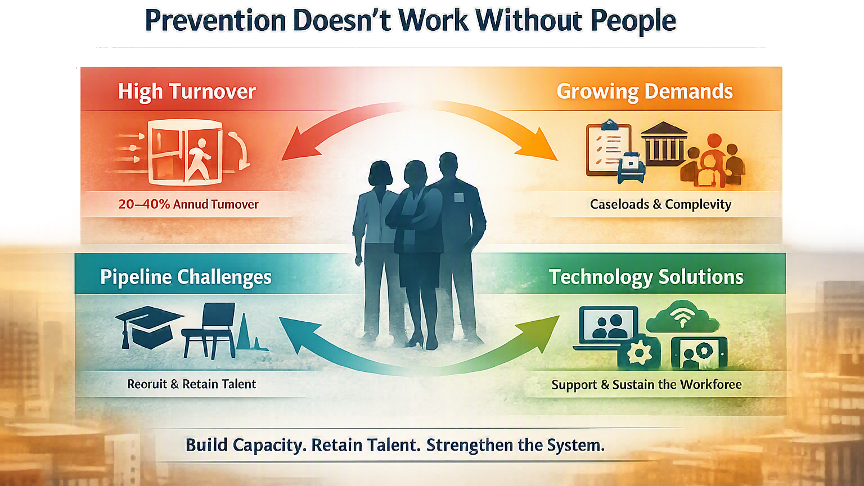
The data tells a different story. National turnover rates in child welfare consistently range between 20% and 40% annually, averaging roughly 30%. More than half of supervisors report turnover has increased, especially post-COVID. This is not a short-term disruption; it is a sustained workforce challenge.
And turnover doesn’t just impact agencies. It affects the consistency of decision-making, engagement with families, placement stability, and ultimately outcomes for children
At the same time, expectations placed on the workforce continue to grow:
Implementing evidence-based programs
Navigating increasingly complex family systems
Managing court involvement and safety decisions
Carrying caseloads that often exceed recommended levels
The result is predictable: Burnout. Turnover. Instability.
We Are Responding – But Not Solving the Problem
Across the country, systems are adapting by broadening degree requirements, hiring from adjacent fields, expanding eligibility for positions, and increasing caseloads. These are short-term responses to structural issues, and in many cases they are creating their own challenges for an already strained system.
We know workforce capacity is not simply a recruitment problem. It is a retention problem. And more fundamentally, it is a question of whether the work itself is sustainable.
We Cannot Separate Policy from Workforce Reality
Programs do not scale in isolation. They require skilled staff, consistent supervision, stable teams, and the local capacity to support implementation. Those elements are easy to overlook in policy discussions, but they are often the difference between a program that succeeds and one that never achieves its promise.
Child welfare has never been purely program-driven. It is, and always has been, a people-driven system.
Where I See a Path Forward
There is real opportunity in front of us, but it requires reframing the conversation. We need to invest not only in policy, programs, and funding structures, but also in the conditions that allow people to enter this work and choose to stay.
That means strengthening workforce pipelines through IV-E and other recruitment strategies, aligning compensation and workload with the complexity of the role, investing in supervision and professional development, and creating clearer long-term career pathways. But we also need to be honest about the reality facing the field:
Even if we successfully recruit and retain more workers, demand is continuing to outpace capacity in many communities.
That is why technology must become part of the workforce conversation, not as a replacement for professionals, but as a force multiplier for the people we already have. When designed intentionally, technology can reduce administrative burden, support more consistent decision-making, accelerate training and onboarding, expand access to supervision and services in rural communities, and provide workers with real-time access to information that helps them make better decisions for children and families.
Technology can be particularly important in rural and underserved communities, where recruitment pipelines are smaller, access to training and supervision is more limited, and retention challenges are often more acute. Thoughtfully designed solutions can help expand access to expertise, support virtual supervision models, and reduce geographic barriers that have historically constrained capacity.
For years, child welfare has largely viewed technology through the lens of compliance and data collection. The greater opportunity is to view it as a workforce strategy. Because if workforce shortages, turnover, and growing service demands are among the system's greatest constraints, then tools that increase capacity, improve consistency, and make the work more sustainable must be part of the solution.
The future of child welfare will not be built through workforce investments alone – or through technology alone. It will require both.
A Final Thought
Technology vendors also have a responsibility to rethink the problems they are trying to solve. For too long, innovation in child welfare has been measured by compliance, reporting, system modernization, and data collection. Those investments matter. But the persistence of workforce instability suggests we may not be measuring the outcomes that matter most.
A different question is emerging: What if every technology investment was evaluated against its impact on workforce retention?
Will it reduce administrative burden?
Will it improve supervision?
Will it accelerate onboarding?
Will it support better decisions?
Will it give workers more time with families and less time navigating systems?
Will it increase the likelihood that skilled professionals choose to stay?
If workforce capacity is one of the greatest challenges facing child welfare, then workforce retention should become one of the industry's most important innovation goals.
At Rosemond HumanTech Solutions, we believe the next generation of child welfare technology must be grounded in the realities of the workforce. Our role is not simply to introduce technology into human services systems. It is to help bridge the gap between practitioners, administrators, policymakers, and technology partners so that real workforce challenges are translated into practical, scalable solutions.
The most effective innovations will not come from vendors working in isolation. They will come from deeper partnerships with the state and local jurisdictions that live these challenges every day.
Because the future of child welfare technology is not about replacing people. It is about helping people succeed. And if prevention ultimately depends on human capacity, then the most important innovation challenge in front of us is clear:
How do we build technology that helps skilled professionals stay, thrive, and continue doing the work that children and families depend on?



Comments